Use cases
This methodology can be applied to different use cases. The following diagram presents three main profiles that can use the CAMSS Tools.
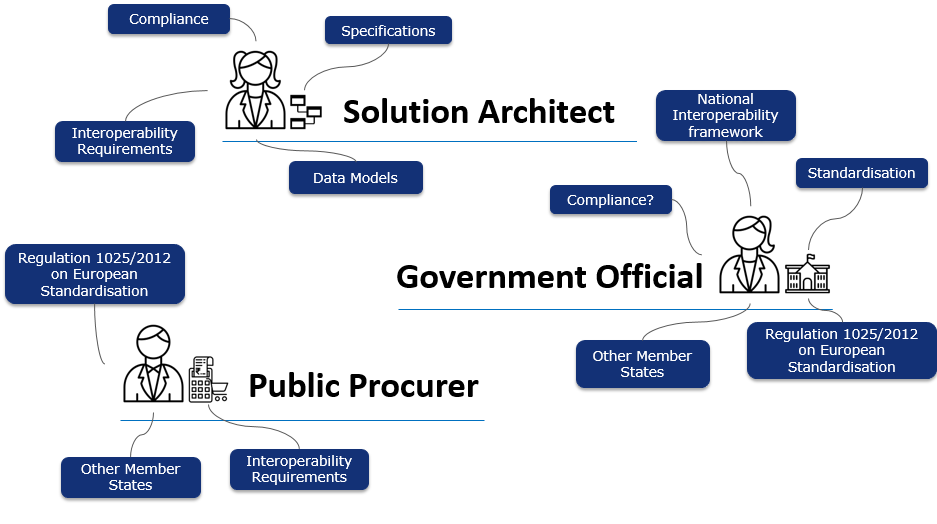
Fig. 1 Diagram of possible users that are involved in the use cases
Solution Architect is the person in charge of leading the practice and introducing the overall technical vision for a particular solution.
Government Official is an official who works for a government department.
Public Procurer is a person who is involved in procurement processes.
Solution Architect
As a Solution Architect, I want to assess a technical specification so I can determine its suitability as an interoperability enabler by evaluating it against the requirements of the European Interoperability Framework.
Government Official
As a Government Official in a Member State, in charge of developing the national catalogue of standards, I want to assess a technical specification so I can collect the evidence that it complies with the principles of the European Interoperability Framework (EIF).
As a Government Official in a Member State, I want to assess a (national) technical specification in an effort to support its developmental improvement towards their recognition as EU or at least cross-border standards.
Public Procurer
As a Public Procurer, I want to assess the compliance of a specification with the requirements laid out in the standardisation regulation 1025/2012 to determine if I can reference it in my public procurement documents (e.g. Terms of Reference).
As a Public Procurer, I want to provide clear technical requirements in the procurement requests I issue in terms of specifications for a solution’s building blocks.
Consideration on assessing families of specifications
Specifications belonging to a family of specifications often depend on their companion documents to be fully implemented. This fact may influence the overall assessment performance, the score of which may be reduced.
To prevent this from happening, when evaluating a specification belonging to a specification family, it is important that, instead of considering the specification in isolation, consider the feature that can achieve by leveraging other specifications from the family. For this reason, whenever possible, it is important to mention the specification together with the accompanying documents, to emphasize their complementarity and positively justify the assessment criteria.
The same reasoning applies to individual specifications whose functionalities can be enhanced with extensions and/or complementary specifications, such as DNS and DNSSec or HTTP and HTTPS. In these cases, the approach should be the same as the one used to evaluate families of specifications.
Another case that can lead to misunderstanding and answering negatively harming the score of the specification is when a specification has been built over another de facto standard or relevant specifications. To illustrate, a simple case that brings light to the situation is the extension of Core Vocabularies. Some vocabularies are used as the basis, or directly extended. In those cases, the specification cannot be hampered by depending on external specifications. A case where it happens is in both CAMSS Vocabularies, the CSSV and the CAV, which reuse DCAT or the CCCEV in the case of the CAV.